Biography of Phiz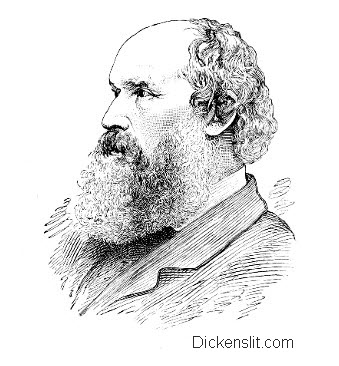 Portrait of "Phiz" (H. K. Browne) A Memoir of "Phiz" (H. K. Browne), Dickens' Most Famous Illustrator "Fizz, Whizz, or something of that sort," humorous TOM HOOD would say,when trying to recall the pseudonym that has since become so familiar bymeans of the innumerable works of art to which it was appended. At thetime HABLOT[A] KNIGHT BROWNE first used this quaint _soubriquet_, it wascustomary to look upon book-illustrators as second, or even third-rateartists--mere hacks in fact; and for this reason they usually suppressedtheir real names, in order to give themselves the opportunity of earningthe title of _artist_, when producing more ambitious results aspainters. Occasionally, whether by accident or design, the subject ofthis memoir would affix his real name to his illustrations; and thepublic were consequently under the impression that the two signatureswere those of different artists, and were even wont to remark that"_Browne's work was better than that of 'Phiz!_'" It is not, perhaps, generally known that the artist's first _nom decrayon_ was "NEMO," which to some extent bears out the above statementthat a book-illustrator was considered a "nobody." Mr. BROWNE himself,in referring to the _Pickwick Papers_, gave the followingexplanation:--"I think I signed myself as 'NEMO' to my first etchings(those of No. 4) before adopting 'Phiz' as my _soubriquet_, toharmonize--I suppose--better with Dickens' 'Boz.'" It is only on theearliest printed plates in some copies of the _Pickwick Papers_ that thesignature of "NEMO" can be faintly traced. 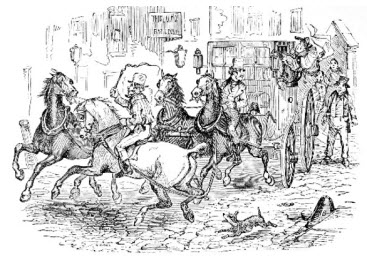 The Departure, by Phiz HABLOT KNIGHT BROWNE, son of William Loder Browne, a descendant from aNorfolk family, was born on the 12th of July, 1815, at Kennington,London. He was educated at a private school in Norfolk, and from anearly age evinced a taste for drawing, which, being recognized by hisrelatives, induced them to apprentice him to FINDEN, the well-knownline-engraver. An anecdote is told of him during his apprenticeshipwhich will bear repetition. Finding BROWNE very painstaking andconscientious, his master usually sent him with engraved plates to theprinter, in order that he might superintend the operation ofproof-taking. As printers usually take their own time over such matters,the youth found that this waiting the pressman's pleasure tried hispatience too much. It therefore occurred to him that to spend theinterval in the British Museum, hard by, would be much more suited tohis tastes. On his returning with the proofs, FINDEN would praise theboy's diligence, little thinking what trick had been practised on him. Line-engraving, however, did not find much favour with the future"Phiz," the process being too tedious; for FINDEN would probably occupysome weeks to produce a small plate, which by the quicker process ofetching, could have been executed in as many hours. He accordinglysuspended operations in that quarter, and, in conjunction with a youngkindred spirit, hired a small attic, and employed his time in the morefascinating pursuit of water-colour drawing, which he continued tofollow with remarkable assiduity until a few days before his death. 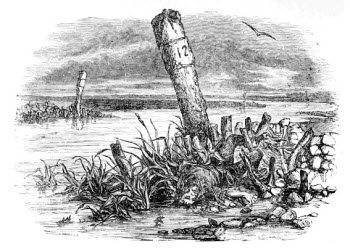 The Death of Quilp, from The Old Curiosity Shop, by Charles Dickens These juvenile disciples of the brush then worked hard at drawing incolour. BROWNE paid his share of the rent in drawings, which he producedrapidly; indeed, there was a solemn compact between the co-workers to"do three a day"--they subsisting, meanwhile, on the simplest fare. Atthis time he attended the evening class at the "Life" School in St.Martin's Lane, and was a fellow-pupil with ETTY, the famous painter ofthe "nude." It was BROWNE'S great delight to watch this talented studentat work, and he considerably neglected his own studies in consequence. At the age of seventeen, or thereabouts, he succeeded in gaining a medaloffered for competition by the Society of Arts for the bestrepresentation of an historical subject; and was again fortunate inobtaining a prize, from the same Society, for a large etching of "JohnGilpin." Mr. GEORGE AUGUSTUS SALA, himself an artist of no smallability, remembers to have seen, in a shop-window in Wardour Street, acertain print by a young man named HABLOT BROWNE, representing theinvoluntary flight of John Gilpin, scattering the pigs and poultry inhis never-to-be-forgotten ride. By the time he had attained his twentieth year he had acquiredconsiderable facility with the pencil. CHARLES DICKENS, but three yearshis senior, and with whom the name of "Phiz" is inseparably connected,had just then made a wonderful reputation by his "Sketches," which firstappeared, at intervals, during 1834-5, and were afterwards published inbook form, illustrated by the renowned GEORGE CRUIKSHANK. In 1836, there appeared in print a pamphlet of some forty or fiftypages, entitled _Sunday under Three Heads--As it is; as Sabbath Billswould make it; as it might be made_; "By Timothy Sparks; illustrated byH. K. B.;" and dedicated to the Bishop of London. The author was CHARLESDICKENS, whose satire was levelled at Sir Andrew Agnew and the extremeSabbatarian party, and had immediate reference to a bill "for the betterobservance of the Sabbath," which the House of Commons had recentlythrown out by a small majority. The illustrations in this little workwere drawn by HABLOT BROWNE, and are very choice examples ofwood-engraving of the school that existed half a century ago. Itsoriginal price was one shilling, but having become very scarce, it isnow worth more than its weight in gold. These early productions of BROWNE'S pencil at once introduced him topublic notice, and DICKENS showed his appreciation of their excellenceby selecting him as the illustrator of the _Pickwick Papers_, whichappeared during the early part of that year. It is well known to thereaders of Forster's _Life of Dickens_, that the idea of "Pickwick" wassuggested to the author by ROBERT SEYMOUR, whose tastes induced him toetch a few plates of sporting subjects to which DICKENS was to supplythe text. Thus commenced that immortal work known as _The PosthumousPapers of the Pickwick Club_. SEYMOUR produced seven illustrations, whenhe committed suicide, which obliged the publishers to make arrangementswith another artist. R. W. BUSS[B] succeeded SEYMOUR, and etched twoplates, which DICKENS, who had by this time assumed the control of thework, thought so unsatisfactory (as indeed they were), that he declinedhis further services. Here a fresh opening was created, and WILLIAMMAKEPEACE THACKERAY competed with HABLOT KNIGHT BROWNE for the post;both submitting to DICKENS' inspection some specimens of their work. Next: a List of the Principal Works Illustrated by Phiz
|
|