Charles Dickens

Charles Dickens
Have a heart that never hardens, and a temper that never tires, and a touch that never hurts.
-- Charles Dickens (1812-1870)


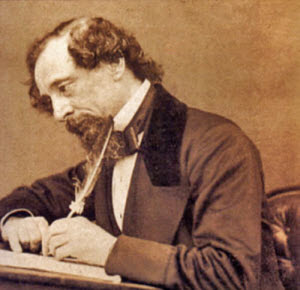
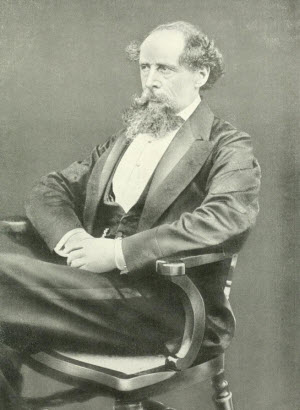
Charles Dickens (February 7, 1812–June 9, 1870), pen-name "Boz", was a very popular and prolific British author who lived and wrote during the Victorian Era. He was the author of over two dozen books, many of which are considered masterpieces of English literature. Dickens' works are still widely read today, while most of his Victorian contemporaries have faded into unread obscurity. Though written for publication in serial form in magazines, the novels of Charles Dickens are deeply complex (often maddeningly so) with multiple layers of meaning, differing viewpoints, and large numbers of well-drawn major and minor characters.

DickensLit.com is a comprehensive archive of information and online resources about Charles Dickens. Here you can read the complete the works of Charles Dickens, including his novels, short stories and magazine articles and download audiobook versions of his works.

This site also features an online biography of Charles Dickens and other useful resources including plot summaries of his major works, a dictionary of Dickens' major literary characters, as well as texts and information about Victorian England. For example, we will soon be adding online copies of the magazine Punch as well as other newspapers and periodicals from Dickens' time, to give the reader an opportunity to see what Britain was really like during the time that Dickens was writing.


Short Biography of Charles Dickens

Dickens Biography

Charles Dickens was born on Friday, February 7, 1812 at Landport, then a little suburb of Portsmouth, England. His father, John Dickens, was a clerk in the navy pay-office at the Portsmouth dockyard. Many of Dickens' novels display a familiarity with navy life and sailors, which he may have picked up from his father.

In 1814, Dickens father was recalled to London and then transferred again, in 1816, to the Chatham.

In Chatham, the family lived in Ordnance Place, and Charles Dickens was sent to a school kept in Gibraltar Place, New Road, by William Giles. As a child Charles Dickens is said to have been a great reader, and very early began to attempt original writing.

Dickens' Early Life

Dickens Early Life

In 1821, when Charles Dickens was nine years of age, the family fell into financial trouble. Reforms and cutbacks at the British Admiralty resulted in Dickens' father losing his position and most of his income.

To cut costs, the Dickens family moved to shabby lodgings on a dingy street in Camden Town but soon after the father lost his position and the greater part of his income. Charles Dickens family could not afford even these impoverished lodgings and the family soon fell into debt. In those days, people who did not pay their debts were imprisoned until their debts were paid off. And Dickens father was soon arrested ant taken to the debtor's prison called the Marshalsea.

Charles Dickens could no longer attend school; the family could not afford it. Instead, at the age of 9, Dickens was sent to work in a blacking factory at Hungerford Market, where he put the labels on the blacking-bottles, with half a dozen rough and rude boys. Working conditions for all factory employees in Victorian England were extremely poor; their pay was low and the hours long. In many ways the factories of Victorian Engalnd resembled the sweat shops that exist in many Asian countries today; the use of child laborers was common. For children working in these sweat shops, the working conditions were abysmal. The degradation and misery of Dickens factory work sunk deep into the boy's soul. As an adult Charles Dickens could never bear to speak of this time; it was never mentioned in his presence. But many of his works allude to the abuse suffered by poor children in Victorian factories.

Not only was Charles Dickens forced to work all day when he was only nine years old, often spending over 12 hours a day in the factory, but in the evening and at night, he was completely on his own. His father was in prison and his mother had moved in with her husband in the jail; young Charles Dickens was expected to fend for himself, living in a barren bedroom, four miles from where he worked. On Sundays Dickens visited his father and mother in the prison. It is difficult to imagine the effect that this kind of life must have had on Charles Dickens emotional development; he might easily have turned to crime and delinquency. Yet as an adult, Charles Dickens was known for endless energy and an optimistic view of life.

Dickens formal education was at the age of nine, when he was sent to work in the factory. It is incredible that this neglected and completely unsupervised boy, not only survived but that he grew up be a successful author.

Fortunately, Dickens parents were eventually able to find a room on Lant Street, close to the prison, so that he could at least be close to his parents. And a few years later, Dickens father was released from jail and the family went back to Camden Town, where Dickens resumed his studies at a public school. It was there that Dickens became a great devourer of books, reading all the plays and books that he could get.

Dickens as Young Man

Unfortunately, this relatively happy period did not last long. The Dickens family was still in poor financial shape and so young Charles Dickens was again withdrawn from school and sent to work. This time he was sent to work in a solicitor's office. Though this was an improvement over working in a sweat shop, young boys working in solicitors' offices in Victorian England had to work incredibly hard: they had to copy documents for their employer by hand (there were of course no photopiers); the copy had to be perfect, despite the poor lighting delivered by oil or gas lamp.

A picture of Charles Dickens at the age of 18
Charles Dickens as Young Man


Dickens detested working in the lawyer's office and his scathing denunciation of the legal system in Bleak house may have been influenced by his work as a clerk in a lawyer's office. Dickens grew determined to find a better life and aspired to be a reporter like his father, who had at this time found work as a newspaper reporter. Dickens taught himself short hand and he frequented the British Museum and its library daily in order to fill in the gaps in his education.

When he was seventeen, Charles Dickens became a reporter, but by then Dickens had a new goal: he wanted to be an actor. All his life, Dickens loved acting and the theatre above all things. Charles Dickens would likely have made a good actor; in later life he lectured extensively and those who heard his lectures commented that he had a great stage presence.


Sketches by Boz

It was not until Charles Dickens was 22 years old that he succeeded in getting permanent employment on the staff of a London paper as a reporter. In this capacity he was sent about the country to cover stories. It was difficult, tiring work. Dickens had to travel hundreds of miles on rough roads on stage coaches that had no suspension system. At the time there were no railways. "I have been upset," be said years afterwards, speaking of this time, "in almost every description of vehicle used in this country."

Dickens work as a reporter was valuable to his later career as a novelist. It exposed him to all types of people and social situations. He was an accurate observer of human behaviour and mannerisms, and what he saw and the people he met as a reporter gave him material for creating his fictional characters.

In December 1833 the Monthly Magazine published Dickens' first original work, called "A Dinner at Poplar Walk." Other articles followed, but at first Dickens did not receive any payment because the magazine could not afford to pay anything.

Dickens articles proved popular, however, and led another magazine, The Evening Chronicle, to hire Dickens as a reporter, and contributing writer. Dickens now earned the considerable sum of five to seven guineas per week. he was only twenty-three.

Later, the sketches that he wrote for the Evening Chronicle were collected and published under the title, Sketches by Boz. Boz was the pen name that Dickens used at the time. The publisher paid 150 pounds for the copyright for Sketches. Many years later, after Dickens had become a literary success, he would buy back the copyright to his first book for four times what he had originally received.

Dickens's Marriage

A Portrait of Charles Dickens and His Wife and Sister
A Portrait of Charles Dickens
and His Wife and Sister

In March of 1836, Dickens married Catherine (Hogarth) Dickens, the daughter of his friend George Hogarth, editor of the Evening Chronicle. The couple would have ten children, and they would separate in 1858 amid rumours of Dickens' infidelity. Divorce was rare in those days so Dickens and Catherine remained married, but lived apart. Dickens formed a relationship with a stage actress; it is not clear whether they ever lived together but at his death Dickens left her a considerable portion of his estate. This account gives a fuller description of Dickens' personal life.


How Dickens' Early Life Influenced His Writing

Dickens' London

No article about Charles Dickens, no matter how short, can avoid a discussion of his early childhood. The events of his youth influenced Charles Dickens and his writings profoundly. To the very end of his life there is not a single work in which some of the characters, some of the places, are not derived from his early recollections. There are many other writers who have passed their childish days among the lower classes, but none who have remembered their ways, their speech, and their modes of thought with as much detail and affection as Charles Dickens. For example, the debtors prison in Little Dorrit is the same prison, the Marshalsea, where Dickens'father was detained and where for two years young Charles Dickens went in and out. The rooms occupied by Bob Sawyer were modeled after Dickens' own lodgings. The Cathedral in the Mystery of Edwin Drood was the same church in whose shadow Dickens had lived. And David Copperfield, the friendless boy, was Charles Dickens himself. Mr. Micawbar is an elegy to his own father. And so on. But although Dickens drew heavily on his childhood experiences for inspiration and based many of his characters on real people that he had known, Dickens found his childhood too painful to speak about directly and only his friend and biographer, Forster, knew that he was, himself, with all the shabby, mean surroundings in early life, exactly like David Copperfield.

The rest of Dickens' life as a writer was one success after success. It was a long triumphal march. He had no failures; he suffered no defeats. Dickens was honoured and respected during his lifetime. There were times when his hand was not at its best, but never a time when his hand lost its power. This indeed seems the crowning happiness of a successful and singularly happy life, that when Charles Dickens was cut off -- he died 9th June 1870 -- after fifty-eight years of continuous work, his brain was still as vigorous, his eye as keen, his hand as sure as in the first fresh running of his youth. Charles Dickens was buried in the Poet's Corner of Westminster Abbey amid other literary greats such as Chaucer. His fame has not diminished with the passage of time. None of Dickens' works has ever gone out of print since it was first published; and every one of his books has been translated into foreign languages, and many have been made into movies.

His Principal Writings

Principal Works of Charles Dickens

The following is the list of books by Charles Dickens in their order of appearance, omitting minor works and essays: Sketches by Boz (1836), The Posthumous Papers of the Pickwick Club (1837), Oliver Twist (1838), Nicholas Nickleby (1839), The Old Curiosity Shop (1840-41), Barnaby Rudge (1841), American Notes ( 1842), )Martin Chuzzlewit ( 1843), The Christmas Tales -viz. The Christmas Carol, The Chimes, The Cricket on the Hearth, The Battle of Life, The Haunted Man, and The Ghost's Bargain (1843, 1848, and 1848); Pictures from Italy ( 1845 ), Dombey and Son ( 1846-48), David Copperfield ( 1849-50), Bleak House ( 1852-53), The Child's History of England (1854), Hard Times (1854), Little Dorrit (1855-57), A Tale of Two Cities (1859), The Uncommercial Traveller (1861), the Christmas numbers in Household Words and All the Year Round, Great Expectations (1860-61), Our Mutual Friend (1864--65), The Mystery of Edwin Drood (unfinished).

This long list by no means represents the whole work of Charles Dickens. Public readings both in England and in America, private theatricals, speeches, letters innumerable, journeys many, pamphlets, plays, the conduct of a popular magazine - first called Household Words and then All the Year Round - and an ever-present readiness to enjoy the society of his friends, fill up the space when he was not actually writing. That Charles Dickens could do so much was mainly due to his orderly and methodical habits, to his clearness of mind, and to a capacity for business as wonderful as his genius for fiction. He knew no rest from the day when he first attacked shorthand to the day when he fell from his chair in the fit from which he never recovered. Charles Dickens was incomparably the most active man, the hardest-working man of his age. In the history of letters there are many, who have produced more work in bulk; there is not one who led a life so varied, so full, so constantly busy, so active and so rich.

Charles Dickens was the champion of the middle and lower classes of his time, but that great section of the community had greatly changed in just a few years since the days when Charles Dickens lived among them and observed them.

A critic of the time wrote: "With the decay of these manners some part of present popularity must certainly pass out of his work: already a generation has appeared to whom a great deal of Dickens's work proves of no interest, because it portrays manners with which they are not familiar. They do not laugh with those who laughed fifty, forty, twenty years ago, because the people depicted have vanished. But when the second quarter of this century shall belong so truly to the past, that not one survives who can remember it, then these books will become a precious storehouse for the study and the recovery of past, and that a large part, of its life and manners. "

Dickens' Talent as a Writer

Dickens Talent as a Writer

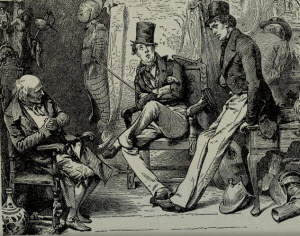
Again, it is the essential quality of genius to create the literary type. In this Dickens has been more successful than any other novelist, ancient or modern. With him every leading character stands for his class. Squeers is the representative of the schoolmaster, then too common, ignorant, brutal, and grasping; Winkle is the Cockney sportsman; it is impossible to think of red tape without naming Mr Tite Barnacle; and so on through all the books. If he sometimes too plainly labels his characters with their qualities and defects, it is a fault caused by his own clearness of conception and of execution. It is another note of genius to suffer every character to work out its own fate without weakness or pity, and though Dickens deals seldom with the greater tragedies of the world in his domestic dramas, necessity pursues his characters as grimly and certainly as in real life.

The villain Quilp and his tool make us forget, in the amusement which they cause, their own baseness. But their creator is not deceived. He makes , them bring their own ruin upon their heads. To be true, not only to the outward presentment and speech and thought of a character, but also to the laws which surround him, and to the consequences of his actions, is a rare thing indeed with those who practise the art of fiction. Further, in this art there are permissible certain exaggerations, as upon the stage. There is exaggeration of feature, exaggeration of talk, exaggeration of action. There are degrees of exaggeration, by which one passes through tragedy, comedy, farce, and burlesque; but in all there must be exaggeration. Dickens was master of exaggeration - if he sometimes carried it too far, he produced farce, but never burlesque. As for selection, which is perhaps the most important point after exaggeration, it came to him by instinct; he knew from the very outset how to select. It is by selection that the novelist maintains the interest of his story and develops his characters. There are countless things that are said and done in the progress of the history which have little interest and small bearing on the things which have to be told; and it is the first mark of the bad novelist that he does not know how to suppress irrelevant scenes.

In the constructive branch of his art Charles Dickens continually advanced. His earlier stories seem, like the Pickwick Papers, to be made up of scenes. Nicholas Nickleby is a long series of scenes brilliantly drawn, in which new characters are always appearing and playing their disconnected part and disappearing. But as he grew older his conception of the story itself grew clearer, and his arrangement more artistic. It is however in description that Dickens proved himself so great a master.

Charles Dickens laid his hand by instinct upon the salient and characteristic features, and he never failed in finding the right -- the only words fit for their illustration. In description he is never conventional, I always real, and yet he allows himself, here as in his scenes of character and dialogue a certain exaggeration which produces the happiest effects. In the hands of his imitators it becomes grotesque and intolerable.

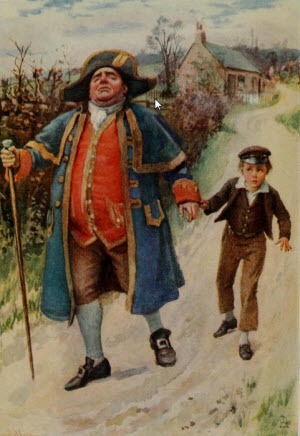
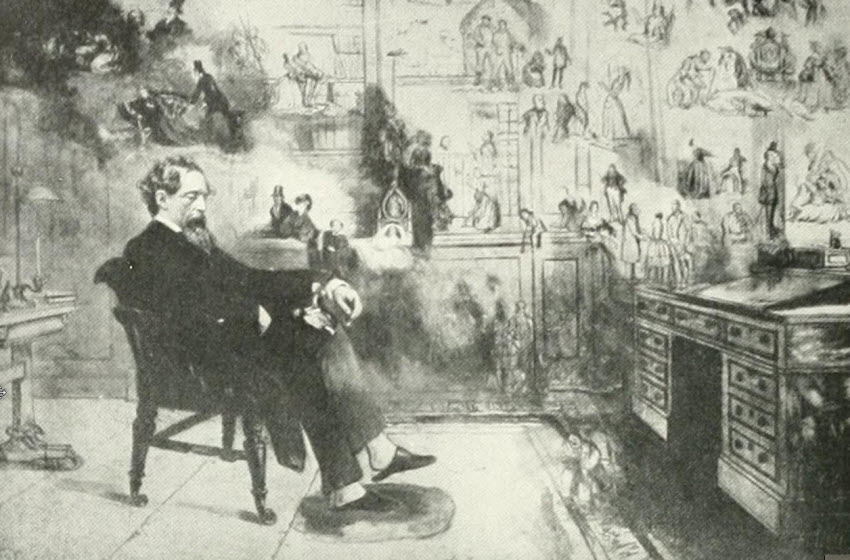
As to Dickens' great and splendid gallery of portraits it is difficult to speak briefly. He created memorable and vivid characters: from the repulsive Uriah Heep, to the loveable Oliver Twist and David Copperfield. The whole of London life -- the life of the streets, of the city, of the middle class -- seems at first sight depicted in this gallery. Here are merchant, shopkeeper, and clerk, lawyer and client, moneylender and victim, dressmaker, actor -- one knows not what. Yet there are great omissions. The scholar, the divine, the statesman, the country gentleman -- all important parts of Victorian society -- are absent, partly because Dickens had no knowledge of them, and partly because he forebore to hold them up to the ridicule which he loved to pour over his characters.

Dickens' methods imposed upon him certain limitations; he aimed at commanding his readers' attention by compelling laughter and tears, but especially laughter. He who can command neither the one nor the other is no true artist in fiction. But in his laughter and in his tears one feels always the kindly heart as well as the skilful hand. It is for the former -- for the deeply human heart -- even more than for the latter that the world will continue to love the memory of Charles Dickens.

Charles Dickens Bibliography

This is a list of the principal works by Charles Dickens In addition to the publications listed, Dickens wrote a number of shorter pieces including short stories.
Dickens Writing Desk


The Works of Charles Dickens in Chronological Order:
  • Sketches 1836-37
  • Sunday under Three Heads 1836
  • The Village Coquettes 1836
  • The Strange Gentleman 1837
  • Pickwick Papers 1837
  • Oliver Twist 1838
  • Sketches of Young Gentlemen 1838
  • Memoirs of Joseph Grimaldi 1838
  • Nicholas Nickleby 1839
  • Sketches of Young Couples 1840
  • Master Humphrey's Clock (The Old Curiosity Shop and
  • Barnaby Rudge) 1840-1
  • American Notes 1842
  • Christmas Carol by Charles Dickens 1843
  • Martin Chuzzlewit by Charles Dickens 1844
  • The Chimes 1845
  • Cricket on the Hearth 1846
  • Pictures from Italy 1846
  • Battle of Life 1846
  • Dombey and Son by Charles Dickens 1848
  • Haunted Man 1848
  • David Copperfield by Charles Dickens 1850
  • Mr. Nightingale's Diary 1851
  • Child's History of England 1852-4
  • Bleak House by Charles Dickens 1853.
  • Hard Times 1854
  • Little Dorrit by Charles Dickens 1857
  • Hunted Down 1859
  • Tale of Two Cities 1859
  • Great Expectations 1861
  • Uncommercial Traveller 1861
  • Our Mutual Friend 1865
  • Mystery of Edwin Drood 1870


Google

Navigation
  • Site Map
  • Dickens Bio
  • Dickens Photographs


  • Sponsors


    Page copy protected against web site content infringement by Copyscape
    Charles Dickens - Home | Charles Dickens Biography | Charles Dickens Photographs | Dickens Audiobook Downloads | 
    About | Site News |  Privacy Policy (updated)  |  Site News  | Search Terms